

The conversation about gender in the 2026 UN Secretary-General race is genuine, overdue, and correctly motivated. In eighty years and nine Secretaries-General, not one has been a woman. That is not an accident. It is a revealed preference.
And naming it accurately requires asking not only whether the next SG will be a woman, but what kind of authority a female SG would actually be permitted to exercise, and why those are two different questions.
The selection mechanism that will produce the next Secretary-General is not designed to select the most capable leader for the mandate. It is designed to produce the candidate whom the five permanent Security Council members can all accept.
That distinction is foundational, and not new. It was built into the architecture in 1945. The great powers would participate in the institution only if their participation was structurally protected from the consequences of the institution’s own principles. The Security Council veto is the clearest expression of that bargain. The proximity-and-compromise criterion governing the SG appointment is its human expression.
This means the process selects, by design, against candidates with strong and independent positions on anything that directly threatens a permanent member’s interests. Not because anyone fails to notice, but because candidates with that profile cannot pass the P5 consensus requirement. Any candidate who would use the Secretary-General’s office to hold permanent members to account would be filtered out before the straw polls. The Blue Smoke working group, which has tracked this selection process for years, documents precisely this: the current system lacks transparency, meritocracy, and accountability, and produces outcomes shaped more by geopolitical dealmaking than by the mandate’s requirements.
This is not a procedural failure that better reform proposals might correct at the margins. It is what the process was built to produce.
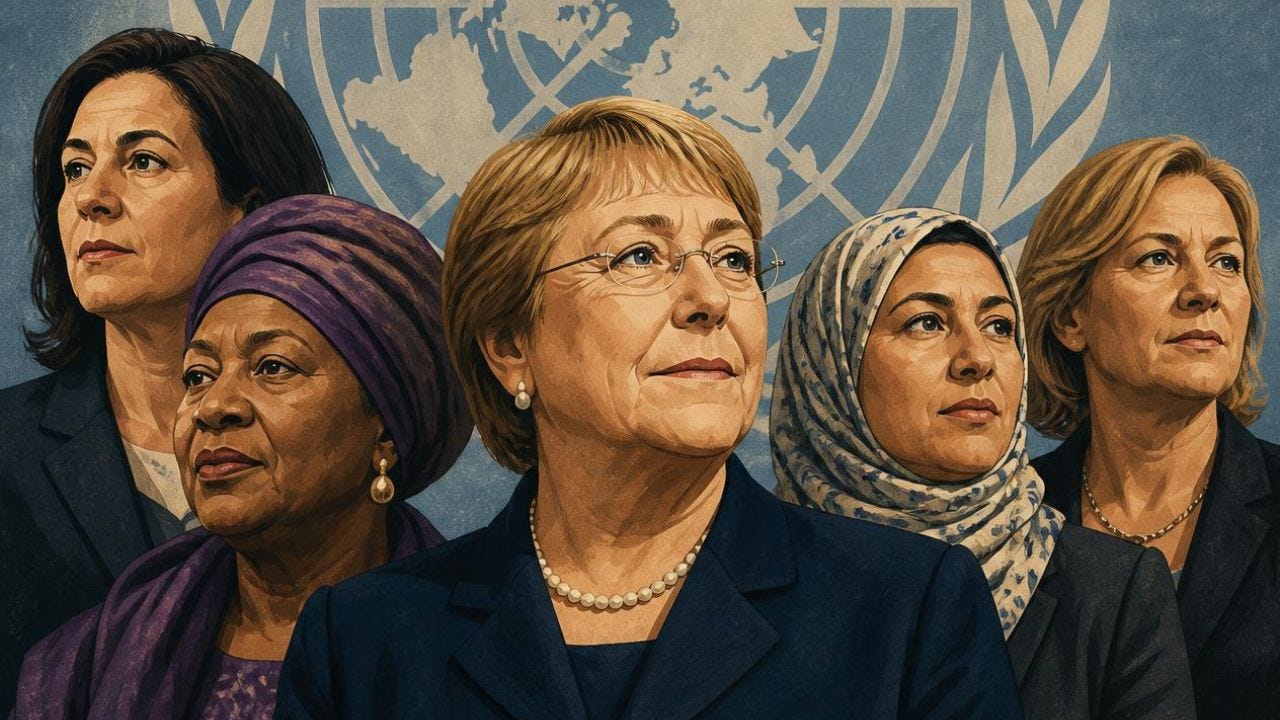
Bachelet, Espinosa, Grynspan, Grossi, Sall: each candidate who releases a manifesto, faces a public hearing, and speaks in the language of Charter principles is navigating this gap. Three of the five are women. The April interactive dialogues gave civil society and member states a view of their stated positions.
The actual decision will be made in a different room, in late July, when the Security Council conducts its straw polls behind closed doors. No formal competency framework governs that process. No public accountability to the populations the institution is mandated to serve. What governs it is the informal weight of five states whose cooperation is the structural condition of the institution’s survival.
The gender conversation around the SG race focuses overwhelmingly on the apex: will the next SG be a woman. As though the glass ceiling at the top is the primary site of the gender problem.
What this framing consistently misses is what the institution has been doing with gender at every level below.
By 2024, gender parity had been reached at the International Professional and Higher Categories for the first time, and 28 UN entities met parity targets, up from just five in 2017. The institution can point to these as evidence of genuine progress. What they do not measure is what the women counted in those statistics were permitted to do once they arrived.
This is the distinction the institution’s gender discourse consistently blurs: between the numerical project of parity and the substantive project of power. Parity is a question of presence: are women in the room, at the table, in the title. Power is a different question: are they making the decisions, controlling the resources, setting the agenda, and when they do so, are they protected in the same way their male counterparts are protected. The answer to the first question has improved measurably. The answer to the second is more complicated.
The informal network through which real institutional power consolidates operates on proximity, not gender. Its specifically gendered expression is this: women in senior multilateral roles are rarely formally excluded from these networks. They are present at the reception, invited to the dinner, copied on the email. What they are frequently excluded from is the register of the relationship in which the real exchange happens. That exclusion shapes what information reaches them, who advocates for them when they are not in the room, and how much institutional protection they can count on when they need it.
The informal network’s function is specific. It is where positions are established before the formal meeting begins, so that the meeting itself ratifies what has already been decided. It is where someone advocates for a colleague when she is not in the room, or does not. It is where information about what is politically viable, which proposals will survive, which conflicts are worth picking, moves between people before any formal channel carries it. Women who gain conditional access to this network gain access to these functions. Women who do not remain formally equal in the process and practically disadvantaged in outcomes in ways the formal record cannot see.
Women who learn to calibrate their visible priorities to the network’s interests gain conditional access to its benefits. But the terms are the network’s terms, not theirs. The alignment is the price. And it has a specific institutional consequence: these are frequently the women through whom the exclusion of other women is most effectively managed. The institution can point to the presence of aligned women in the network as evidence of inclusion. What the diversity metric cannot capture is that the inclusion is conditional, the condition is alignment, and it serves the protection architecture rather than the mandate.
The parity ceiling is not the glass ceiling. The glass ceiling prevents women from reaching senior positions. The parity ceiling is something more interior: the invisible constraint on what authority those positions actually contain. It is the gap between the title and the power the title is understood to confer, distributed along gendered lines in ways the institution does not acknowledge and its gender reporting does not measure.
The clearest current evidence is Francesca Albanese. Her profile, female, European, credentialed international lawyer, satisfies virtually every criterion the institution’s diversity discourse identifies as desirable. She was appointed through proper procedure, her mandate renewed by the Human Rights Council for a further three years. She has been doing precisely what her mandate requires: producing rigorous, evidence-based findings through the lens of international law.
The institutional response has been managed distance from her findings, US government sanctions, and a Secretary-General’s spokesperson who affirmed the Special Rapporteur architecture in general while declining to use the language she uses.
Profile, procedural legitimacy, and mandate compliance offered no protection when political alignment was absent. In the institution’s actual operating logic, the fourth condition overrides the first three.
This is not an argument against a female Secretary-General. A female SG would be a genuine marker of institutional evolution. It would send a different signal to the women inside the system navigating its structural marginalisation. It would change something real about the symbolic register in which the institution presents itself to the world. The UN Pact for the Future explicitly regrets that no woman has ever held the role. Eighty years of unbroken male succession is a failure with consequences that representation alone can begin to address. These things matter.
But they are distinct from the structural question. A female SG selected through the existing proximity-and-compromise mechanism would be the product of that mechanism. She would carry all its constraints. The informal authority network that the institution’s gender reporting cannot see would not be restructured by her appointment. The parity ceiling that operates at every level of the professional class would not be lifted by a change at the top of the hierarchy that produced it. The political logic that sanctioned Albanese’s findings would continue to govern what the role can do.
Two reforms are needed simultaneously, and they address different levels of the same problem.
The first is structural: the selection mechanism itself needs to be redesigned around a formal competency framework with some form of public accountability, so that the proximity-and-compromise criterion is at least partially constrained by the mandate’s actual requirements. The Blue Smoke working group has documented what this could look like in practice.
The second is cultural: the informal authority dynamics that produce the parity ceiling need to be named in institutional discourse with the same precision the institution applies to its numerical targets. Not just who is present, but what they were permitted to do.
Selecting the first female Secretary-General would be historic. Whether what follows is renewal or reproduction of the same structural logic depends on whether the harder questions are on the table alongside it: not only who is selected, but by what criterion, and what she will actually be permitted to do once appointed.
Without those questions, the glass ceiling becomes the story. And the architecture that sustains the parity ceiling remains invisible beneath the celebration.
This article draws on Institutional Gravity: Exiting Authority, Reclaiming Mandate by Moon Ting Li, forthcoming. Referenced sources include the UN Women Transparency Portal (2024 gender parity data), the Blue Smoke working group reports on UN senior appointments (UNA-UK, 2022-2026), the Dag Hammarskjöld Foundation’s 2020 report on UN leadership, and the UN Pact for the Future (2024).