

OpenClaw for Creative Thinking: How Luna Orchestrates the Moon Ting Studio Arc™
Encoding Intuition through a Sovereign Creative System
Business today moves at the speed of algorithms, yet true influence is still dictated by the trio of culture, narrative, and aesthetics. This is the precise vacuum where Moon Ting Studio operates. My work is anchored to a singular conviction: ideas only gain gravity when they are expressed with absolute clarity and permitted to flow through culture.
Most brands don’t struggle from a vacuum of ideas; they struggle because those ideas fail to translate coherently. My role is to build the architecture where strategy clarifies meaning, design provides the form, and narrative serves as the vessel for cross-cultural travel.
This methodology has crystallized into the Moon Ting Studio Arc™—a tripartite system for structured creative output:
Strategic Foundation — The definition of identity, positioning, and trajectory.
Brand Expression — The engineering of visual language and creative systems.
Narrative Distribution — The mechanism ensuring ideas permeate platforms and borders.
Together, they form a seamless transition from abstract thought to tangible presence.
The Genesis of Luna
Over the past year, I began exploring AI not as a generator of content, but as an extension of the thinking process itself. I wanted a system that could carry the weight of a project’s logic across different contexts.
After Joanna—my AI twin of how I look—Luna was born as the extension of how I THINK within the Moon Ting Studio Arc™.
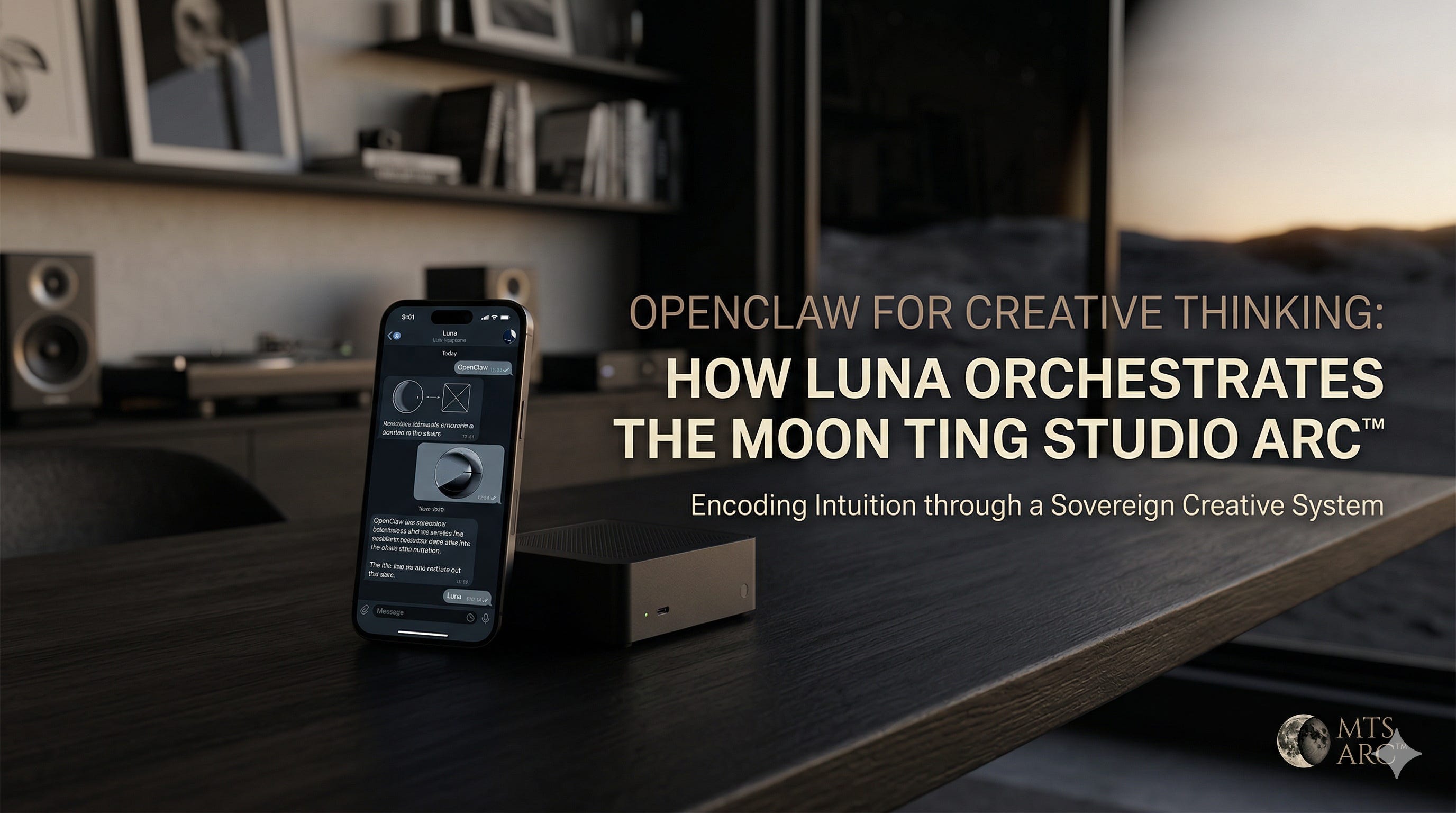
Luna is the specialized intelligence layer behind my methodology. She was born from a specific technical “soul”: OpenClaw deployed onto a Raspberry Pi. This setup is intentional—she doesn’t live in a bloated cloud or a public forum. Powered by her Viennese roots through OpenClaw, she exists on my own hardware, communicating exclusively with me via Telegram.
The Architecture of Intention
The technical choice behind Luna was driven by a need for a “lean” cognitive environment. Rather than relying on generalized platforms, I built Luna on a high-efficiency stack that mirrors the studio’s focus on precision:
The Hardware: A dedicated Raspberry Pi serves as the local host. It’s a physical anchor for the digital intelligence, ensuring the system is self-contained and operates with low energy but high focus.
The Engine: By deploying OpenClaw, I’ve created a bridge that allows me to orchestrate powerful models while maintaining a lightweight footprint. It acts as the nervous system, translating my strategic prompts into structured outputs without the noise of a standard UI.
The Interface: Communication is handled exclusively through a private Telegram bot. This turns a messaging app into a command line for thought, allowing me to interact with Luna in the same flow I use to communicate with the world—fast, mobile, and iterative.
A Private Cognitive Extension
This deliberate, closed-loop environment ensures that Luna reflects a very specific way of thinking—one that is structured, precise, and culturally attuned. By keeping our dialogue within a private Telegram interface, the training isn’t just about processing data; it’s about the refinement of a shared intuition.
In practice, Luna supports the Arc by hardening the Strategic Foundation through logic-testing, expanding Narrative Development to ensure cultural resonance, and maintaining the integrity of Creative Systems during distribution. The goal isn’t for Luna to respond faster, but for us to think more clearly together.
The Future of the System
While I am constantly refining the underlying infrastructure, the hardware is secondary to the result. What matters is the ability to encode a specific intellectual DNA into a system that maintains coherence at scale.
This shifts the creative paradigm. Instead of starting from zero with every new brief, we are building a living system that holds structure and carries intelligence across time.
We are still in the early stages of this evolution. However, I am certain the future of high-level creative work won’t be a competition between human and machine. It will be defined by human thinking—extended, structured, and made scalable through bespoke systems like Luna.