

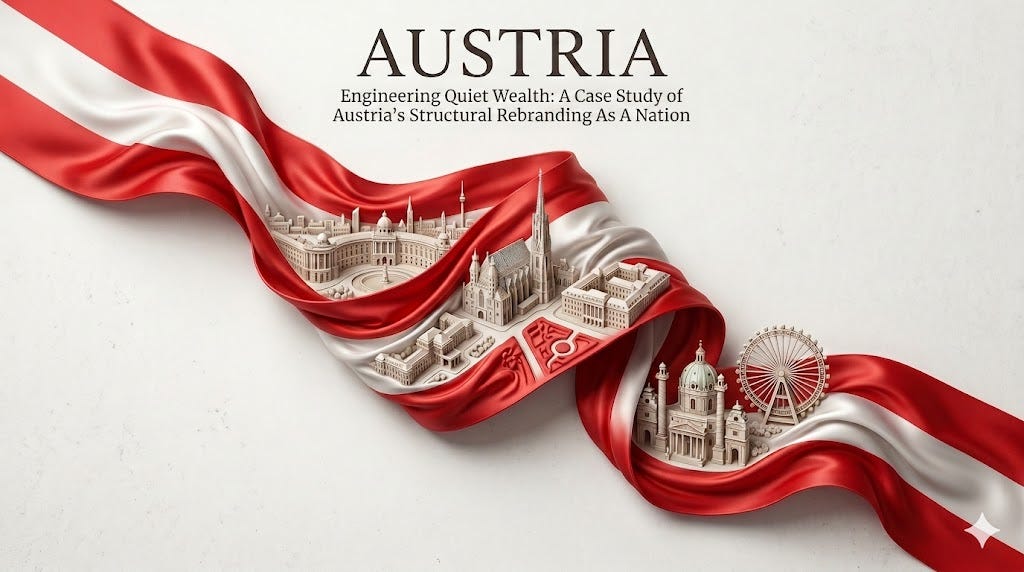
Most people think branding is about storytelling. But the brands that truly reshape the world are never talked into existence. They are forced into existence—by structure.
Austria is one of the most extreme, and most overlooked, examples. This is not a story of national recovery. It is a case of structural rebranding at the level of a state.
On the surface, Austria’s story seems simple: an empire collapses, a country rebuilds, prosperity follows. But that’s a misreading. What Austria actually accomplished was not recovery but something far more radical: it rewrote the conditions of its own existence. It didn’t try to prove that it was still a great power. Instead, it redesigned what kind of country it could become. That is the essence of rebranding.
In my work, I tend to think of rebranding across four layers: structure, narrative, expression, and distribution. Most attempts focus on the latter two — how something looks, how it is told. Austria took the opposite path. It changed the first layer. Everything that followed was an extension of that choice.
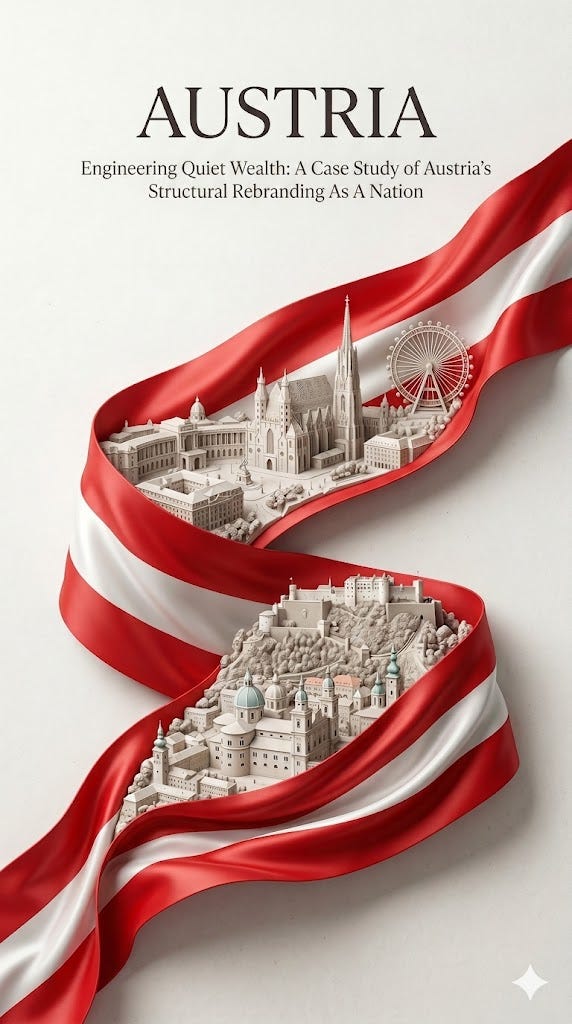
If you go back to 1945, it is difficult to imagine this outcome.
Vienna looked like something repeatedly shattered and ground down. Streets fractured, buildings collapsed, the air thick with dust and hunger. The city was divided into four occupation zones — not just a geographic split, but a breakdown of order itself. The economy had regressed to its most primitive form: cigarettes traded for medicine, food rationed.
At that point, the trajectory of most countries would already be set. Austria didn’t follow it. The first move it made was subtle, and conventional narratives rarely emphasize it. But structurally, it was decisive.
In the 1943 Moscow Declaration, the Allies defined Austria as “the first victim of Nazi aggression.” Historically, this is debatable — Vienna’s cheering crowds in 1938 are well documented. But after the war, Austrian political elites seized on this framing and turned it into something materially consequential. Austria was not treated like West Germany. No heavy reparations, no equivalent structural reckoning. It was positioned as a liberated country rather than a defeated one, which meant its starting point was not a debt-laden ruin but a reset ruin. On the surface, a narrative advantage. More importantly, it became structural.
This was a case where narrative strategy altered the trajectory of a nation — yet what proved decisive was not the narrative itself, but the moment it was translated into structure.
Then came capital.
The United States, wary of Austria drifting into the Soviet sphere, injected one of the highest per capita allocations of Marshall Plan aid into the country. For a small population, this was an extraordinarily dense infusion. But capital alone doesn’t determine outcomes. What matters is how it gets used.
In the Soviet-controlled zones, factories were dismantled and shipped east — machines removed, lightbulbs unscrewed and taken away. On the western side, Austria chose differently. It didn’t simply rebuild. It took control.
Industrial assets built under Nazi Germany — steel plants, chemical works, engineering facilities — were treated as ownerless. The Austrian state moved quickly to absorb them, forming the basis of a national industrial system centered on steel, energy, and heavy engineering. Neither pure free-market capitalism nor a Soviet model, but something more pragmatic: the state held strategic assets while markets handled operational efficiency. You won’t find this step in any branding narrative, but it determined every narrative that followed.
The next shift was even more counterintuitive. In most industrial economies, labor conflict is structural — strikes, disputes, cycles of confrontation, almost expected. In Austria, conflict didn’t disappear. It was relocated. Not to the streets, but to the room.
The chambers of labour, commerce, and agriculture were not external pressure groups. They were embedded within the system. Any major economic policy had to be negotiated among them before reaching parliament. Many decisions were shaped not in public debate but in closed rooms, over long negotiations — sometimes with wine on the table, and long stretches of silence. The result was not the absence of conflict but its pre-resolution. Where other countries measured strike activity in days, Austria often measured it in seconds, if at all.
This stability was engineered, not cultural. Labor accepted wage restraint. Companies avoided aggressive layoffs. The state reduced living costs through housing and public services. Short-term gains compressed, long-term predictability expanded. And for capital, that meant something very simple: it could stay.
Once that structural stability was in place, Austria could finally decide what it wanted to be. No resource advantage. No scale advantage. A domestic market too small to support a consumption-driven model. It couldn’t compete on size, so it changed the question. Instead of asking “how much can we produce?” it asked: “where can we become impossible to replace?”
The economy that emerged is very specific — and almost invisible. You may not know the names of its companies, but you’ve likely encountered their work. The cable car on a ski slope: very possibly Austrian. The aircraft fire truck racing toward a burning fuselage: likely Austrian. The eco-fiber in high-end clothing: possibly derived from Austrian wood pulp. These firms don’t chase scale or depend on brand visibility. They occupy extremely narrow segments and dominate them globally. That near-invisibility is precisely what makes them so hard to displace.
In 1989, another inflection point arrived. The Berlin Wall fell, the Cold War ended, and for many countries this was an opportunity. For Austria it was closer to a repositioning — what had been a geopolitical edge suddenly became a center. More importantly, Austria didn’t need to “learn” Eastern Europe. These regions weren’t foreign; they were historically intertwined. The language, the bureaucratic logic, the cultural codes, even the informal systems — all familiar.
So while others hesitated, Austria moved. Banks became the primary instrument: acquiring, rebuilding, expanding, embedding themselves deeply into the financial systems of countries like Slovakia and Romania. Profits began returning to Vienna. Vienna, in turn, shifted from cultural capital to economic hub once again. Not expansion in the conventional sense. Closer to a quiet reclamation.
But what most visibly reshaped everyday life was not finance or industry. It was housing.
Spend time in Vienna and you notice something unusual. The sense of prosperity isn’t only about income — it’s about cost structure. In most cities, housing is pressure. In Vienna, it was redesigned.
Since the early 20th century, the city has continuously built and maintained a large-scale public housing system. What began as worker housing didn’t disappear — it expanded, evolved, and integrated into the broader urban fabric. Today, roughly 60% of the population lives in social or subsidized housing. Not marginal spaces. Different income groups coexist. Rent is determined by cost rather than market competition, which creates a very concrete difference: the same income produces entirely different lives depending on where you are. In one city, rent consumes half your earnings. In another, a fraction. The gap isn’t just financial — it’s structural. Vienna chose to intervene not in income but in the cost of living itself. That decision doesn’t show up cleanly in GDP figures, but it shapes daily life in ways GDP can’t capture.
Austria extended the same logic to nature. The Alps had always been there, and for a long time they represented hardship rather than wealth — poor soil, long winters, limited livelihoods. What changed was not the landscape but its organization. Artificial snow systems, lift infrastructure, large-scale investment: these turned an unpredictable environment into a managed system. Skiing became not just an activity but a structured, repeatable, monetizable experience. Winter became skiing; summer became hiking and wellness; the same infrastructure used across seasons. This did more than generate income — it rebalanced geography. In many countries, cities are rich and rural areas are poor. In Austria, certain alpine regions are wealthier than the cities.
When all of these structures operate together, the system appears almost frictionless. And that’s precisely when the next problem emerges.
A system designed for stability begins to resist change. Demographics shift. The population ages. Pensions are generous, but the burden shifts forward. Politics grows cautious, even static — any reform threatens existing equilibrium, so the safest choice becomes no change. Meanwhile the external world accelerates. Technology, capital, talent all move faster. Austria’s strengths — stability and comfort — start functioning as constraints. Young talent leaves. Firms expand elsewhere. The system keeps running, but its edges become visible.
So what did Austria actually get right? The answer isn’t complicated. It told the right story, then used the leverage of that narrative to rewrite its structure. After that, everything else followed.
What we see today — the wealth, the stability, the livability — isn’t simply the result of narrative, nor purely of structure. It’s what happens when a narrative is successfully realized as structure. That’s why Austria’s image holds: not maintained through persuasion, but reinforced through reality.
The most powerful form of rebranding doesn’t stop at how people see you. It’s how you make every possible perception inevitable.