

Japan’s influence doesn’t come from scale or resources. It comes from something harder to name: the ability to take the question of how the world is perceived and turn that into a system — one that can be trained, repeated, institutionalized, and over time, amplified.
This is what separates Japan from mere refinement. If it were only refinement, you’d get cycles of imitation — styles that rise, circulate, and fade. What Japan built is more durable than style.
Aesthetics in Japan is not confined to art, architecture, gardens, or objects. It is embedded into the default mode of perception itself.
What you encounter in Japan is not a series of isolated beautiful things. It’s a field — composed of space, rhythm, material, relation, order, emptiness, and detail, held together with unusual consistency. This field didn’t appear fully formed. It accumulated over centuries, reinforced through repetition, embedded layer by layer until it stabilized as something structural, something that now operates at the level of the state.
That said, the story is messier than it looks. Japan also produced pachinko parlors, corridors dense with vending machines, and some of the most aggressively cluttered retail interiors on earth. The restraint and the excess coexist — and any honest account has to sit with that tension rather than quietly look away. The aesthetic consistency is real, but it lives alongside its opposite. The more interesting question is: why haven’t they cancelled each other out?
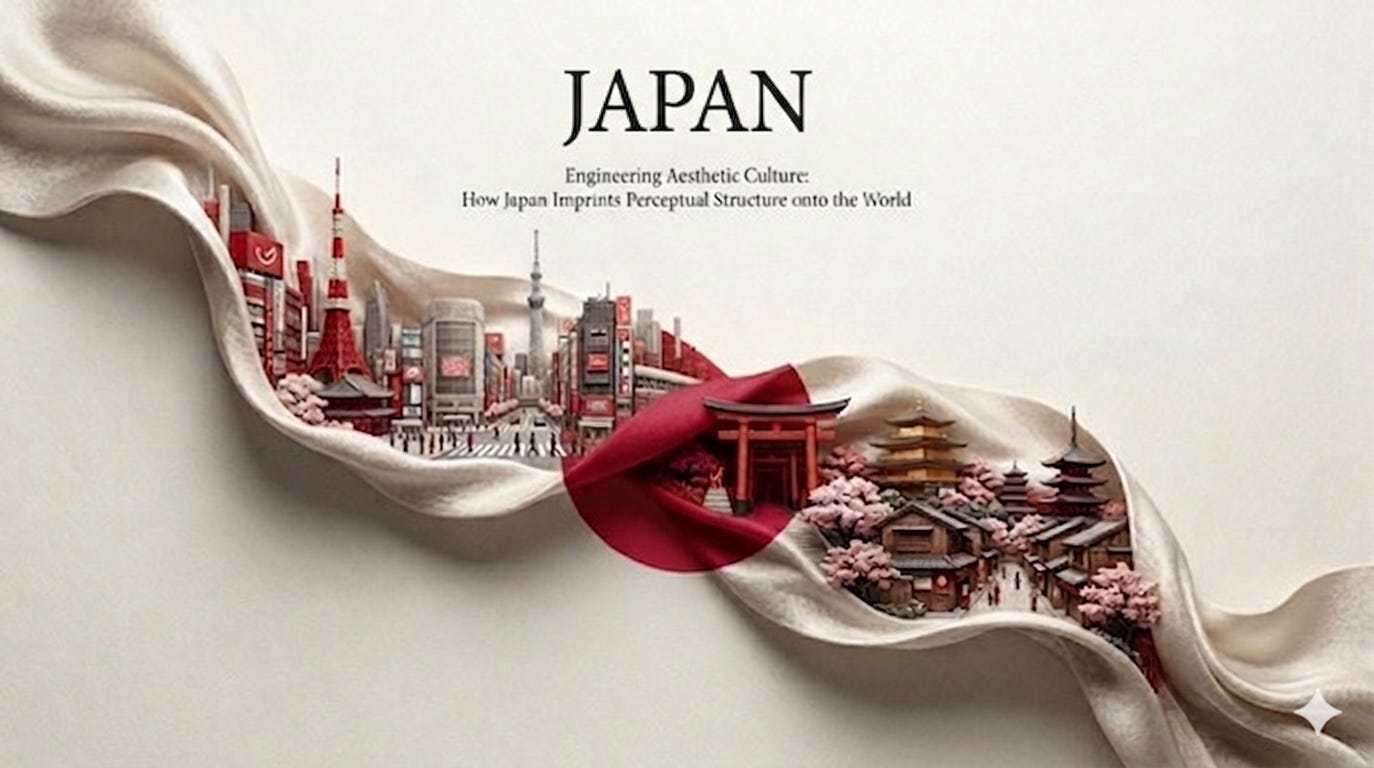
I. The Formation of Japanese Aesthetics: From Miyabi to Iki
Japanese aesthetics did not begin with wabi-sabi. What gets cited endlessly in design circles and lifestyle journalism is only one phase in a much longer continuum.
It starts in the Heian period, when Japan — having spent centuries absorbing Chinese and Korean influences — began articulating something distinctly its own. At the center were two concepts: miyabi and mono no aware.
Miyabi is not luxury. It’s refinement after filtration — emphasizing order, proportion, cultivation, and restraint rather than display. Poetry, architecture, objects: all shaped through a form of control that is precise yet understated. It belongs to a world where what is left out matters as much as what is included.
Alongside miyabi came something deeper: mono no aware. This is not simply an emotion. It’s a moment of contact. Something is seen, heard, or encountered, and before it can be named, the body responds — a slight intake of breath, a quiet “ah.” Not sadness, not joy, but a movement of the heart that precedes explanation. Its most characteristic form is not intensity but transience. The significance of cherry blossoms doesn’t lie in their full bloom; it lies in the moment just before they fall. Beauty detaches from permanence and attaches itself to disappearance. Once time enters aesthetics, the world stops being perceived as a set of stable objects and becomes a continuous process — always already in the act of changing.
With the medieval period and the influence of Zen, this deepened further.
Yūgen shifted the emphasis from feeling to expression. Beauty is not presented directly; it’s revealed through shadow, emptiness, and partial concealment. Meaning resides not in clarity but in what remains just beyond articulation.
Wabi-sabi completed a transformation at the level of value. It doesn’t attempt to repair the world. It accepts incompleteness, instability, and impermanence. Cracks are no longer flaws — they are traces of time. What cannot be preserved becomes precisely what holds.
By the Azuchi-Momoyama period, Japanese aesthetics stopped moving in a single direction. A dual structure emerged: on one side, power and religion produced extreme ornamentation; on the other, Sen no Rikyū pushed the tea ceremony to its radical extreme — simplicity and inwardness pressed almost to the point of dissolution. Within this tension, suki took form. Not simply taste, but a selective structuring of life. Space compressed. Objects reduced. Every flower, every bowl, every pause had to be exactly right.
Then came the Edo period, and iki — which brought aesthetics fully into the urban and social realm. The chōnin, the merchant class, occupied a peculiar position: without the authority to display power, yet unwilling to accept vulgarity, they developed a subtle calibration of presence. Restrained but not austere. Refined but not excessive. Composed, without visible effort.
By this point, Japan had formed a complete aesthetic vocabulary: miyabi, mono no aware, yūgen, wabi-sabi, suki, iki. Not isolated concepts but a system — one that can be activated across different layers of experience, in different eras, through different forms.
II. From Experience to Structure: Masayuki Kurokawa’s Eight Principles
If the above is a historical unfolding, the designer Masayuki Kurokawa’s framework is something more like a structural X-ray. His eight terms — micro, parallel, atmosphere, interval, concealment, rawness, borrowing, rupture — don’t redefine Japanese aesthetics. They reveal how it actually works.
Micro shifts the point of entry. Perception begins from the smallest unit — not the whole but the edge, the texture, the slight displacement that would otherwise go unnoticed. Detail doesn’t decorate the whole; it constructs it.
Parallel reorganizes structure. Multiple elements coexist without forced unification. Difference is not eliminated; it is arranged.
Atmosphere operates beyond form. A space feels right — or it doesn’t. The difference can’t always be explained, but it is immediately perceived.
Interval defines relation. Not emptiness but spacing — the distance that allows things to exist without collapsing into each other.
Concealment gives depth. What is not shown continues to act.
Rawness allows time to participate. Materials are left open to transformation rather than sealed against it.
Borrowing extends the system outward. Space doesn’t end at its boundary; it incorporates what lies beyond.
Rupture is the most counterintuitive. Only after equilibrium is established can it be productively broken. A slight deviation introduces tension — but without the surrounding order, it would dissolve into noise. With order, it generates force. This is why Japanese asymmetry tends to feel intentional where Western asymmetry often just feels sloppy: rupture only works when there’s a stable field to rupture against.
Taken together, these are not aesthetic preferences. They are operational principles — and they help explain how a consistent perceptual structure can persist even as forms change across centuries.
III. “Dō”: How the Body Acquires Judgment
Understanding the principles still leaves a question open: how does any of this get transmitted from one person to the next? Not through explanation. Through repetition.
Dō — literally, “way” or “path” — is the form this transmission takes.
Tea ceremony, flower arrangement, calligraphy, martial arts: these are not simply disciplines. They are systems through which perception is trained in the body rather than the mind. In tea practice, you don’t begin with meaning. You begin with movement — sitting, turning, lifting, placing. Through repetition, something shifts. Not knowledge but sensitivity. Slight changes in rhythm alter the entire felt condition of a room.
Correctness is not imposed. It stabilizes.
At a certain point, repetition produces something else. Judgment no longer arises through comparison or deliberation; it just happens. The body moves before thought intervenes. This is where dō converges with Zen — not as philosophy but as a practical state where perception, judgment, and action are no longer separate operations.
Worth being skeptical about, though. Not everyone who practices tea ceremony achieves this quality of perception. Not every calligrapher develops mushin. The transmission is real, but it’s neither automatic nor universal — it requires conditions, talent, sustained commitment, and probably good instruction. Any account that simply says “repetition installs judgment” skips over the failures, the practice that goes nowhere, the people for whom the door never opens. They belong in this story too.
IV. Institutionalization: When Aesthetics Becomes a Social System
What begins at the level of the individual body extends, in Japan, into the structure of society. The unusual thing is not that aesthetics is promoted — it is that it is embedded, often without being named as aesthetics at all.
In Japanese schools, children clean their own classrooms. Floors are wiped. Desks aligned. Objects returned to their places. Nobody calls this aesthetic training. But across years of repetition, it produces a particular sensitivity: a continuous, low-level awareness of whether a space is in order or slightly off.
This sensitivity doesn’t arrive all at once. It accumulates. And it doesn’t produce artists; it produces a baseline of perception.
As individuals enter industrial systems, this baseline gets transformed into something that looks like quality control but is closer to perceptual attunement. At Toyota, any worker can halt the production line upon sensing an irregularity. The mechanism itself is not unique to Japan — what is notable is the threshold. When is something “off”? It can’t be fully quantified. It depends on familiarity with a stable condition and the ability to detect the smallest shift away from it. That capacity has to be grown somewhere before it shows up on a factory floor.
At the level of the city, the same logic appears. Tokyo is extraordinarily dense, but it rarely collapses into chaos. Space is not maximized; it’s calibrated. Signage stays roughly within proportion. Interiors guide movement without explicit instruction. Flow holds even under pressure. This is not aesthetic policy. It’s the accumulated effect of countless small adjustments made by people who have developed a sensitivity to spatial wrongness and are quietly, continuously correcting for it.
V. Output: When Perceptual Structure Enters the World
Once stabilized internally, this structure extends outward. Japan doesn’t export meaning. It exports experience.
In Studio Ghibli films, narrative slows in ways that feel almost scandalous by contemporary standards. Scenes linger. Wind moves through grass. A figure stands in the rain, doing nothing in particular, and you can’t look away. Nothing resolves. Nothing is explained. The moment is not completed — it is held. This is mono no aware operating not as a concept but as a condition: something already disappearing at the moment it is seen.
In retail, Muji removes excess signals. Space goes quiet. Objects are arranged without insistence. You are not directed; you are allowed. Uniqlo compresses variation and shifts the emphasis from expression to function. In both cases, the experience is the argument — you are being gently trained in a preference you may not even notice acquiring.
In contemporary art, Yayoi Kusama dissolves boundaries through repetition while Takashi Murakami saturates perception through density — opposite methods, the same structural move: perception is reorganized rather than simply pleased.
These outputs don’t ask to be interpreted. They act directly. Repeated across enough contexts — films, objects, shops, artworks — they accumulate into something that looks less like cultural influence and more like a quiet restructuring of what feels right.
VI. A Structure Formed Under Pressure
Japan’s aesthetic structure was not designed. It emerged under conditions where permanence could not be assumed — where earthquakes, storms, and sudden change were not exceptions but background conditions.
In such a context, beauty could not anchor itself in durability. It had to attach to the moment — not as something to preserve but as something to experience fully, precisely because it wouldn’t last. Over time, this stopped being an isolated sensitivity and became a pattern of perception. The pattern proved more durable than any individual style. Judgments that couldn’t be repeated, embedded, and transmitted fell away. What kept working across contexts and centuries stabilized.
Aesthetics became structure. Structure became system. System became environment.
The result is something most cultures don’t quite produce: not a style that can be adopted, but a mode of perception that has to be grown. This is why imitations of Japanese aesthetics so often produce something that looks right but doesn’t feel it — the surface can be copied, but the perceptual training underneath cannot.
In a world organized around speed, scale, and expansion, Japan offers a different possibility: that reality can be organized through finer distinctions rather than larger quantities. Through restraint. Through the precise arrangement of relations. Through the productive use of emptiness.
This mode doesn’t declare itself. It doesn’t make strong claims or expand rapidly. But once you’ve really encountered it — not just seen it — it holds. And it leaves a question that’s harder to shake than it first appears: what would it take to build that kind of perceptual capacity somewhere else, in a different culture, without the centuries of repetition that made it possible here?