

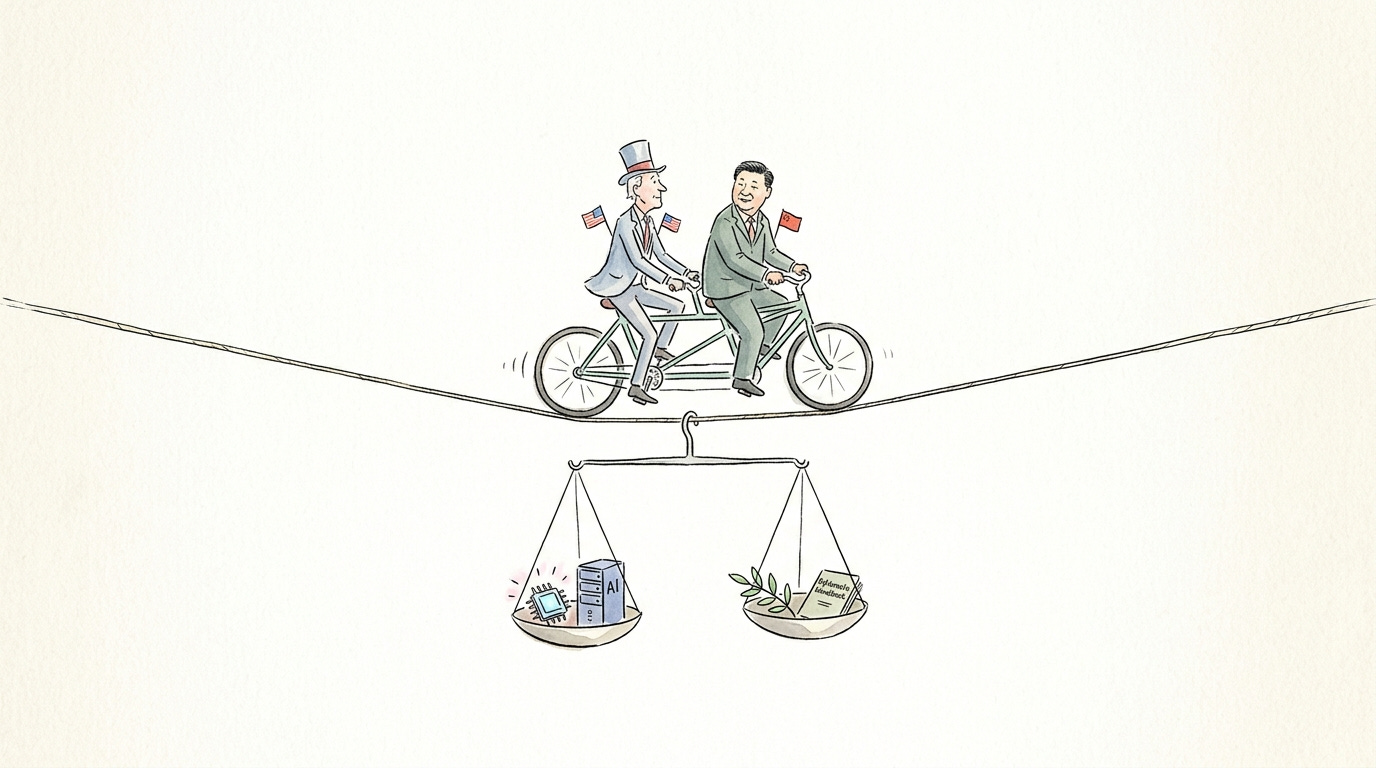
A few weeks before Xi Jinping arrived in Washington, I watched The Brink of War, the new film dramatizing the 1986 Reykjavík Summit between Ronald Reagan and Mikhail Gorbachev.
At first glance, the comparison feels misplaced. Reagan and Gorbachev met at the height of the Cold War, with thousands of nuclear warheads pointed at one another across an ideological divide. Trump and Xi met in a world defined not by nuclear brinkmanship but by tariffs, semiconductors, artificial intelligence, and economic interdependence.
Yet the film left me with a unsettling thought. Forty years apart, both summits were shaped by a similar question: what happens when two rival powers realize they cannot eliminate one another, but neither is willing to stop competing? In 1986, that question helped set the stage for the eventual end of the Cold War. In 2026, it may be producing something very different: not an end to rivalry, but a framework for managing it.
Much of the commentary surrounding Xi Jinping’s state visit focused on what was achieved—or more accurately, what was not achieved. No breakthrough emerged on Taiwan. No grand bargain was reached on trade. No major agreement materialized on artificial intelligence, technology controls, or military competition. Yet to focus solely on policy outcomes is to overlook something equally important.
Diplomacy speaks in more than one language.
There is the language of communiqués, joint statements, and carefully negotiated phrases. But there is also the language of symbolism: ceremonies, protocol, gestures, invitations, military displays, and state rituals. The first language tells us what governments are willing to say. The second often reveals what they believe. To understand the significance of Xi’s visit, it is necessary to read both.
The Language of Symbols
The most striking aspect of the visit was not what was signed, but how Xi Jinping was received.
According to Chinese media accounts, President Trump personally welcomed Xi at the airport, a gesture described as the first of its kind for a visiting foreign leader since the Cold War era. Whether every historical comparison withstands scrutiny, the reception was clearly intended to be extraordinary.
The symbolism continued throughout the visit. Military flyovers accompanied welcoming ceremonies. Cannon salutes punctuated the proceedings. Honor guards lined ceremonial routes. Historical military uniforms were incorporated into the White House welcome ceremony. A state banquet followed, accompanied by a carefully choreographed program that appeared designed to communicate the highest level of diplomatic importance.
Much of the international coverage treated these details as diplomatic theater. But in international politics, theater itself is often the message. States communicate through protocol. Every invitation, every seating arrangement, every ceremonial detail conveys meaning. The question, therefore, is not whether the reception was symbolic. The question is what it symbolized.
One interpretation would be personal. Trump and Xi have often displayed a degree of mutual familiarity absent from many of Trump’s interactions with other world leaders. But a geopolitical explanation is ultimately more persuasive. The significance of the reception was not that Xi was being treated as a friend. It was that he was being treated as a rival of historic consequence.
Throughout history, great powers have often reserved their most elaborate diplomatic gestures not for allies, but for competitors they cannot afford to ignore. This helps explain an otherwise striking contrast. Over the past several years, Trump’s interactions with several allied leaders, including Emmanuel Macron and Volodymyr Zelenskyy, have frequently been marked by public disagreements and unusually blunt rhetoric. During one dispute earlier this year, Macron dismissed Trump’s remarks with a terse response: “I won’t respond to them, they don’t deserve a reply.”
Yet Xi’s visit unfolded in an entirely different register. The ceremonies were solemn. The symbolism was deliberate. The message was unmistakable. Washington wanted the world to understand that China occupies a category of its own: Not an ally. Not an enemy. Something more consequential.
That conclusion becomes even more interesting when viewed alongside Trump’s visit to Beijing earlier in the year.
If diplomacy speaks through symbols, then the two summits resembled less a series of isolated events than an ongoing conversation.
Months before Xi arrived in Washington, Trump had received a reception in Beijing that was equally rich in symbolism, though very different in tone. Beijing did not emphasize military power. Instead, it showcased history, civilization, and political continuity. Trump was welcomed into spaces rarely opened to foreign leaders. He visited the Temple of Heaven, a site historically associated with imperial authority and cosmic order, and was received in Zhongnanhai, the political center of contemporary China. Through state ceremonies, cultural performances, and carefully chosen settings, Beijing projected a narrative that China increasingly seeks to tell about itself: that it is not merely a rising power, but a civilizational state whose legitimacy rests on centuries of continuity and national renewal.
Washington spoke a different symbolic language. Rather than emphasizing history, it emphasized power. Rather than civilizational continuity, it highlighted institutional continuity. The White House, the National Archives, military flyovers, honor guards, cannon salutes, and presidential protocol communicated a different story about national greatness. If Beijing’s reception invited Trump to witness the depth of China’s past, Washington’s reception invited Xi to witness the reach of American power and the durability of American institutions.
Yet beneath these differences lay a striking similarity. Neither side framed the relationship as an alliance. Neither emphasized shared values. Neither sought to present the other as a future partner. Instead, both governments appeared to acknowledge something more fundamental: they were dealing with another center of global power whose influence could neither be ignored nor wished away.
The symbolism therefore revealed a form of mutual recognition. Beijing’s message was not “we are becoming the same.” Washington’s message was not “we are becoming closer.” Both were saying something more restrained—and perhaps more consequential: we recognize each other’s weight.
The Language of Words
If the symbolism conveyed one message, the official diplomatic language conveyed another. Taken together, they pointed toward the same conclusion. The most important outcome of the summit may not have been a policy agreement at all, but the emergence of a shared vocabulary for describing the future of U.S.-China relations.
When Trump visited Beijing earlier this year, both sides began discussing what Chinese officials described as a “constructive strategic stability” framework. During Xi’s visit to Washington, that language evolved further. The concepts of mutual respect, fairness, reciprocity, and stability were repeatedly emphasized by both sides.
At first glance, these phrases appear to be little more than standard diplomatic jargon. But diplomatic language matters because it reflects what governments believe is possible. And what is striking about this language is what it does not contain. It does not speak of partnership. It does not promise cooperation. It does not envision convergence. Instead, it assumes competition.
The question is no longer whether China and the United States are strategic competitors. Both sides appear to have accepted that reality. The question is how that competition can be managed. This represents a profound shift from earlier eras. For decades, much of the debate surrounding China-U.S. relations revolved around two competing assumptions. One school believed engagement would eventually narrow political and strategic differences. Another assumed competition would inevitably culminate in confrontation. Neither vision now appears realistic. What is emerging instead is a framework built on a different premise: rivalry without rupture. Competition without conflict.
Building Guardrails for Rivalry
The most substantive outcomes of the summit were therefore not the headline-grabbing announcements, but the institutional mechanisms quietly taking shape beneath them. The trade truce was extended. Trade and investment consultation mechanisms continued to develop. Discussions expanded regarding crisis-management frameworks and communication channels designed to prevent future escalation. Viewed individually, these developments may seem technical. Viewed collectively, they reveal something more significant.
Both countries are gradually constructing guardrails around competition. This is perhaps the most important difference between the current phase of U.S.-China relations and the trade wars of previous years. The objective is no longer simply to resolve crises after they occur. The objective is to prevent competition from generating crises in the first place. That logic extends beyond economics. The same principle increasingly appears in discussions surrounding military communication, strategic stability, and artificial intelligence. Which brings us to the most consequential arena of all.
The New Arms Race
If the defining competition of the twentieth century was nuclear technology, the defining competition of the twenty-first century may be artificial intelligence. Both Washington and Beijing understand this. Both governments publicly acknowledge the risks associated with advanced AI systems. Yet both continue investing heavily in securing technological leadership. The summit reflected this contradiction. Officials spoke of cooperation and risk management, but no meaningful agreement emerged regarding the competitive dynamics driving AI development.
The reason is straightforward. AI is not merely another technology. It is increasingly viewed as a source of national power. Whoever leads in AI will enjoy advantages in military capability, industrial productivity, scientific innovation, and geopolitical influence. In this sense, today’s AI competition occupies a position in global politics not entirely unlike that occupied by nuclear technology during the Cold War. The technologies are different. The strategic logic is not. Both create incentives for intense competition while simultaneously increasing the risks associated with miscalculation. This is why the language of stability has become so important. The competition is not ending. If anything, it is accelerating. The challenge is ensuring that acceleration does not become escalation.
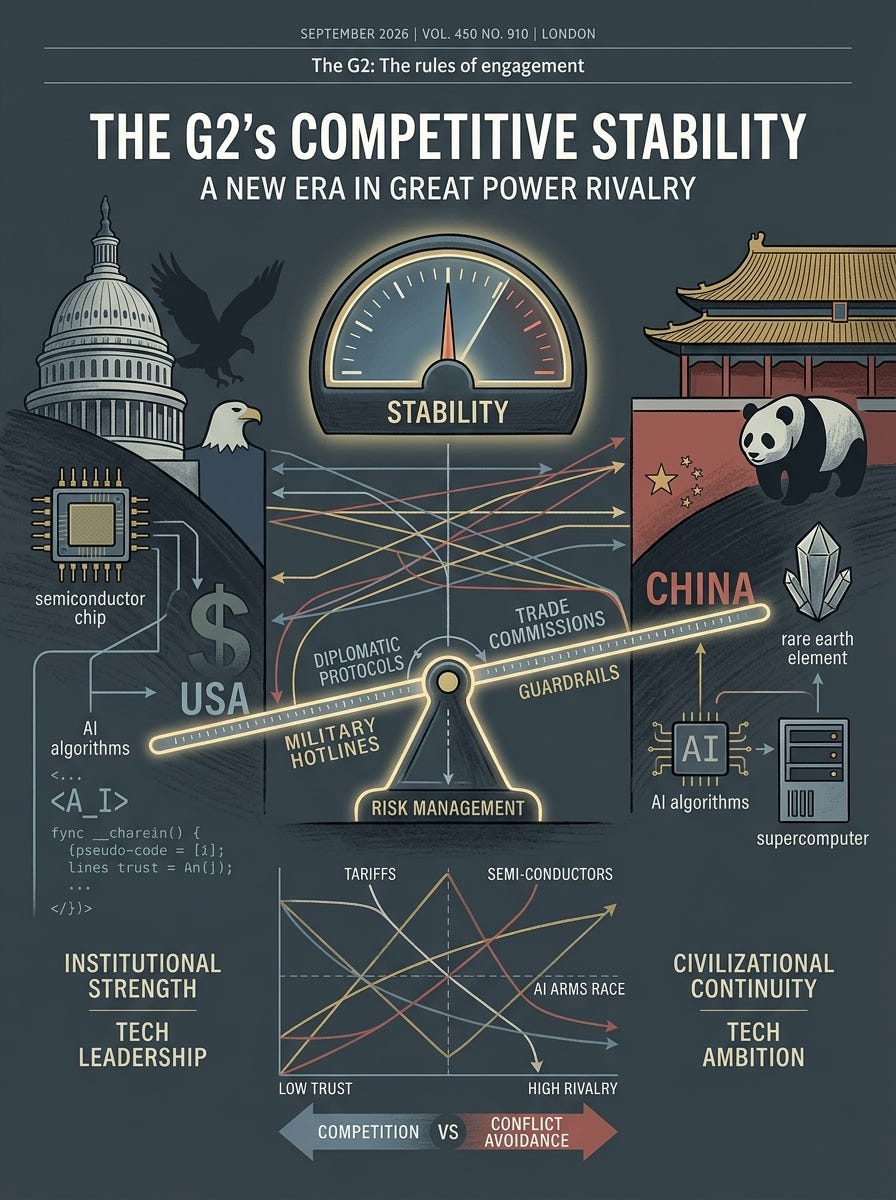
Competitive Stability
This brings us back to the central question raised by The Brink of War. The Reykjavík Summit became historically significant not because Reagan and Gorbachev suddenly trusted one another. They did not. It became significant because both sides recognized that rivalry required rules.
The comparison should not be overstated. The Soviet Union of 1986 was a declining power. China in 2026 is a rising one. Reagan and Gorbachev were laying the groundwork for the end of a confrontation. Trump and Xi appear to be laying the groundwork for its long-term management. Yet both moments share a common insight.
Great powers do not need to become friends in order to coexist. They need mechanisms. They need communication. They need limits. Most importantly, they need a shared understanding of what kind of competition they are engaged in. That may ultimately be the most important message conveyed by Xi Jinping’s visit to Washington.
The fighter jets. The cannon salutes. The state banquet. The carefully crafted diplomatic language. Taken separately, each can be dismissed as symbolism or rhetoric. Taken together, they tell a coherent story. The United States and China are no longer debating whether they are competitors. They are debating how competitors should live together.
The diplomatic language emerging from Washington and Beijing increasingly points toward a new framework for the international order: one in which rivalry remains intense, trust remains low, and competition remains relentless; but where both sides seek to prevent that competition from becoming conflict. Not partnership. Not détente. Not a new Cold War. But something else: A condition that might best be described as competitive stability. And if that framework endures, historians may one day look back on the 2026 Trump-Xi summit not as a breakthrough, but as a moment when the world’s two most consequential powers began to define the rules of a new era.