

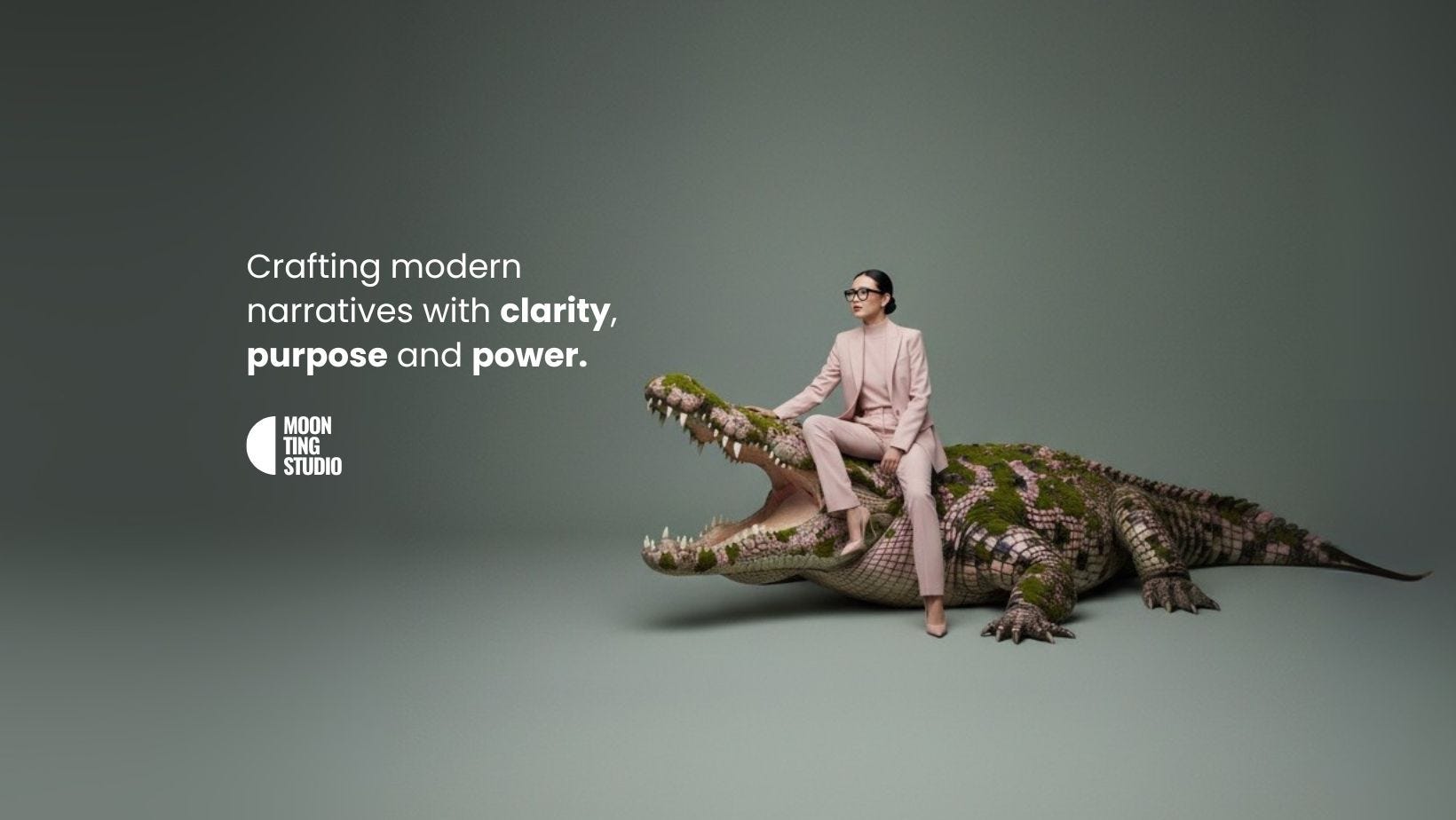
I started Moon Ting Studio because two former UN colleagues asked me to help them figure out who they were becoming.
Both had spent decades doing serious work inside multilateral institutions. Both were stepping into something new. And both were struggling with the same thing: not a lack of ideas, but a lack of a framework to make those ideas legible to a new audience, a new market, a new chapter of their own life.
I recognised the problem immediately. It was the one I had spent my entire career learning to solve.
Those conversations confirmed something I had been circling for a long time: that the skills I had spent a decade building, across communications, journalism, campaign strategy, and creative direction, inside an institution where ideas have to travel across languages, cultures, and political contexts, were precisely what was missing from the way most brand and identity work gets done.
I’m Moon Ting Li, a brand architect, creative director, digital strategist, and journalist based in Vienna. My work sits at the intersection of narrative, aesthetics, and cross-cultural intelligence. In practice, that means helping founders, leaders, and institutions translate complex ideas into identities that hold weight across borders.
Before the studio, I spent more than a decade inside the United Nations system, in Paris, Geneva, and Vienna, working on global campaigns across human rights, justice, gender equality, and digital transformation. Field work took me to Africa, the Middle East, the Americas, and across Asia. It was the kind of work where ideas have to survive contact with many different cultural realities at once, where a story that lands in Geneva may not land in Nairobi, and where clarity is not a stylistic preference but a practical necessity.
The problem I kept encountering had a specific shape. The leader who had spent a decade inside a multilateral institution and could not articulate, in a single sentence, what they now stood for. The brand that resonated deeply in one cultural context and disappeared in another. The founder whose ideas were genuinely important and whose public presence did not yet reflect that.
The common thread was never a communications failure. It was a structural one. The ideas were there. What was missing was the architecture to make them travel. That is the problem this studio exists to solve.
How the studio works
The studio organises its work across four stages, which I call the Arc™.
Identity and positioning first: defining who you are and where you stand before anything is made or said.
Then narrative: the messaging and storytelling architecture that carries that identity into the world.
After that, expression: visual direction, design systems, digital environments, and AI creative systems built to extend a specific identity rather than produce generic output at scale.
And finally, distribution: putting ideas into motion through influence architecture and content systems designed so that what reaches the audience is what was intended at the outset.
Clients may enter at any stage. The work is always connected.
Who this is for
Founders and leaders whose ideas have outgrown their current public presence. Cultural institutions navigating new audiences. Brands entering markets shaped by different aesthetic traditions, particularly across European and Asian contexts.
The studio’s particular depth is in the European–Asian dialogue, two markets with profoundly different relationships to brand, institution, and authority, though the work extends across Africa and the Americas. What I bring to all of it is the ability to move between analytical rigour and aesthetic judgment, between institutional scale and individual voice, between what something means in one cultural context and what it needs to mean in another.
If that is the kind of problem you are working on, I would be glad to hear about it.