

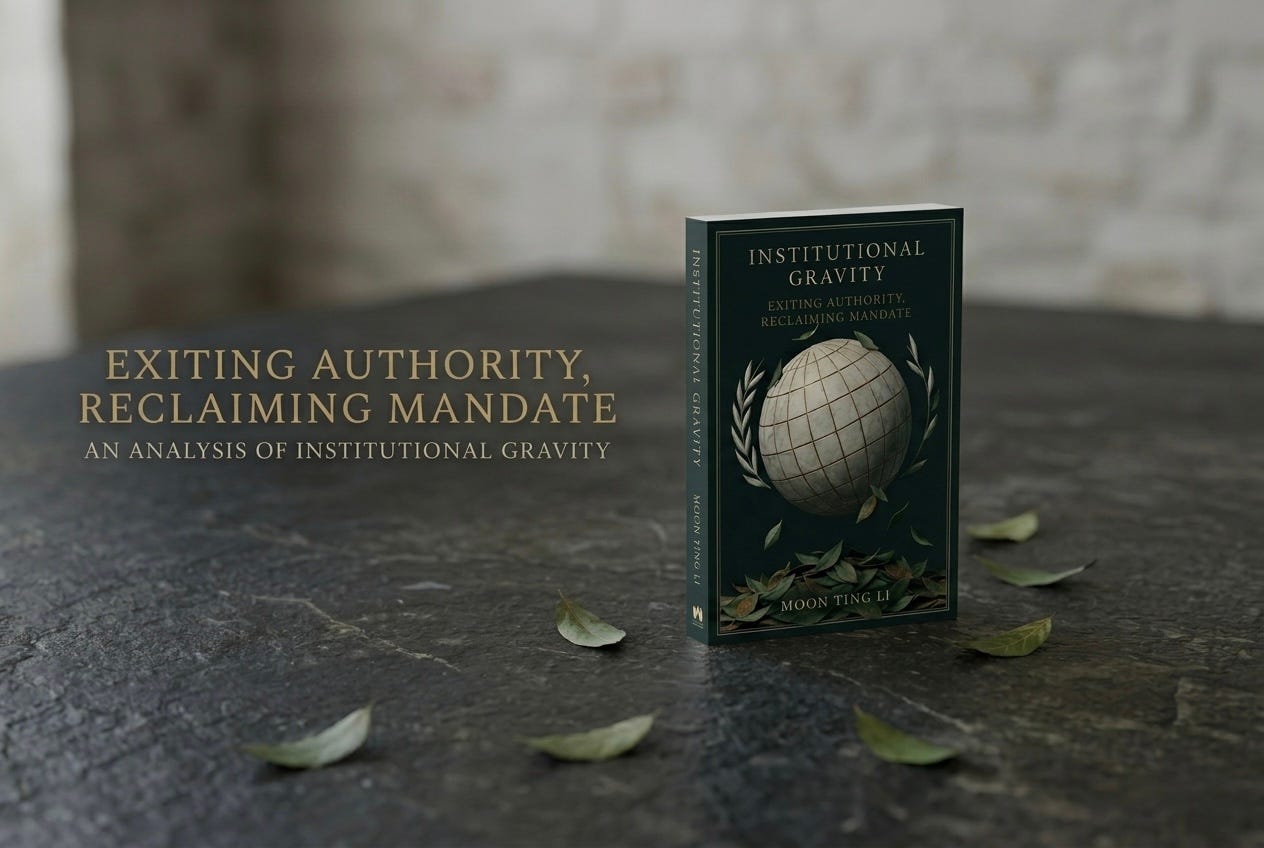
Two colleagues left the United Nations within a few years of each other. Both had worked inside the system for a significant portion of their careers. Both left with the institutional formation that the system produces: the knowledge, the networks, the specific way of reading a room that years inside a multilateral institution will give you. What they built after was different in kind from what they had held before. Not diminished. Different. And the difference was not incidental. It was structural.
That observation grew into a question: what does departure from a large international institution actually reveal, that sustained immersion cannot? And the question grew into fifteen chapters of analysis.
On Institutional Gravity
The title names a concept the book develops across its argument. Institutional gravity operates in two directions simultaneously, and naming both is necessary to understand what the book is examining.
The first vector runs from member states to the institution. The United Nations exists only through the voluntary cooperation of the states that fund and authorize it. The most powerful of those states, the permanent Security Council members, the largest donors, exert a gravitational pull on what the institution can do, what it will say, which crises it will resource and which it will manage with resolutions and reports. The institution bends toward the interests of the states whose cooperation is the condition of its survival. That bending shapes the institution’s culture, its appointment logic, its accountability mechanisms, and the specific gap between what its mandate promises and what its architecture can deliver. Member state gravity is the force that operates from outside and above, pulling the institution away from its own stated principles.
The second vector runs from the institution to the people inside it. Once the institution has been bent by the first force, it exerts its own gravity on the professional class it recruits and forms. The culture that results, the language it produces, the specific kind of discretion it trains, the identity it confers and the identity it requires: all of these shape the people who inhabit the institution in ways that are not always visible while the inhabiting is happening, ways that only become legible in the specific interval after departure, when the frame has loosened enough to be examined as a frame.
On exit, the gravity pulls differently. Not inward but backward: the professional identity, the sense of authority, the specific weight that came from the institutional role, these do not disappear with the badge. They linger, reconfigure, and in many cases transform into something the institution could not have produced while the person was inside it. The book is interested in what that transformation reveals: about the institution, about the structures that govern it, and about what becomes possible when those structures are no longer the operating frame.
The vantage point
The book argues for two specific epistemic positions, related but distinct.
The first is the partially shed insider: the person who has left the institution and is in the interval between frames: no longer inside the institutional logic that would make the old one invisible, and not so far from the experience of inhabiting it that the interior account has faded into abstraction. This is the position the book is written from. Far enough out to examine the architecture as a system, close enough to have carried its logic in the body, the frame becomes visible as a frame.
The second is the partially included: the person who was formally inside the institution but never fully absorbed by it. Someone who took the oath and meant it, who worked for years or decades inside the system, but who navigated it always from the margin of inclusion rather than from its centre. Not the outsider looking in. The insider who was never quite let all the way in, who experienced, from within, the gap between formal inclusion and the informal recognition that makes exclusion operationally real. By gender, by geography, by independence, by simply never having had the institutional wind at their backs.
That position produced a specific angle of vision. Close enough to see how the frame operated. Placed oddly enough to notice what those at the centre, fully absorbed, could not. The partially included did not need to leave to begin to see the architecture. They were never inside it in the way that would have made it invisible.
Neither full immersion nor permanent distance. Both positioned, by different routes, to see the architecture at the specific angle where it becomes examinable.
What the book examines
Across fifteen chapters, the book moves through a sequence of angles on the same institutional condition. It begins with the phenomenology of departure: what leaves with the badge, what persists, what the interval of disorientation actually produces. It moves through the structural mechanisms that govern who enters the professional class, how expertise is recognized and credentialed, how political appointment operates at the apex, how the institution manages its internal accountability and its external legitimacy.
Each chapter names something real. Written in sequence, they reveal something the individual analyses do not: the institution’s expressions of a consistent structural logic, reproduced at every scale of the institution’s operation. The United Nations was not designed to fail. It was built to survive, which is a different thing, and the distinction is at the centre of everything the book examines.
Why now
The book is written at a specific moment in the institution’s history. The United Nations is navigating its most acute financial and political crisis in decades: a funding shortfall that has forced structural contraction, a reform process described by its own staff union as chaotic, incoherent, and rushed, and an SG selection underway that will produce the institution’s next leader through the same opaque P5 negotiation process that has governed every appointment in the institution’s history. The structural conditions the book diagnoses have intensified rather than resolved. If anything, the crisis has made the argument more visible, and the question of what institutional failure means for the project underneath the institution more urgent.
The book is not an argument that the institution should not exist. It is an argument that the institution and the idea it was built to serve are not the same thing, and that confusing them has protected the institution from the scrutiny it requires and its critics from the responsibility their critiques demand. That distinction, held honestly, is where the most useful analysis becomes possible.
It is also the beginning of a public conversation the book is written toward. The structural argument the book makes is not the exclusive property of the book. It will appear here, in essays extracted from the manuscript, in pieces responding to specific institutional moments: the SG selection, the UN80 reform process, the pattern of institutional failures that the current crisis is making legible. The book will be published when it is published. The conversation it is designed to enter has already begun.
If the argument interests you, follow this space. If the vantage point resonates, the work that follows from it will give you more to engage with.
The institutional gravity that shaped the people inside the system does not disappear when they leave. What it becomes, once the frame has loosened, is what this book is about.
Institutional Gravity: Exiting Authority, Reclaiming Mandate by Moon Ting Li is forthcoming. For updates, follow moontingli.com and Moon Ting Studio on LinkedIn.
Subscribe to Millennial Intellectual, a publication of Moon Ting Studio that examines the ideas and identities, power and autonomy, institutions and cultural logics that shaped the world our generation inherited.